
What Is Relative Humidity?
What Is Relative Humidity?
Relative humidity is the percentage of water vapour present in the air compared with the maximum amount of water vapour the air can hold at the same temperature.
It is expressed as % RH.
For example, if the relative humidity is 50% RH, the air contains half of the water vapour it could hold before reaching saturation at that specific temperature.
At 100% RH, the air is saturated. If additional moisture is added, or if the air temperature drops, water vapour may begin to condense into liquid water on surfaces, in ducts, or in the air as fog or mist.
Relative humidity explained scientifically
Air always contains some amount of water vapour. The amount it can hold depends mainly on temperature.
Warm air can hold more water vapour than cold air because water molecules have more energy and remain in vapour form more easily. Cold air reaches saturation with a smaller amount of water vapour.
Relative humidity is therefore not just a measure of how much moisture is in the air. It is a measure of how close the air is to saturation.
The relationship can be described as:
Relative Humidity (%) = Actual water vapour pressure ÷ Saturation water vapour pressure × 100
This means relative humidity changes when temperature changes, even if the actual amount of water vapour in the air remains the same.

Why temperature affects relative humidity
Temperature plays a central role in relative humidity.
When air is heated, its capacity to hold water vapour increases. If no additional moisture is added, the relative humidity decreases.
When air is cooled, its capacity to hold water vapour decreases. If the air cools enough, it may reach the dew point. At the dew point, the air becomes saturated and condensation begins.
This is why condensation often appears on cold windows, metal surfaces, or poorly insulated areas when humid indoor air comes into contact with a cooler surface.
Warm air can hold more moisture
Approximate maximum water vapour capacity of saturated air at different temperatures.
As air temperature rises, the air can hold more water vapour. When cold outdoor air is heated indoors without adding moisture, relative humidity decreases.
Why relative humidity matters in buildings
Relative humidity has a direct effect on human comfort, building materials, equipment, and indoor environmental quality.
When relative humidity is too low, dry air can contribute to:
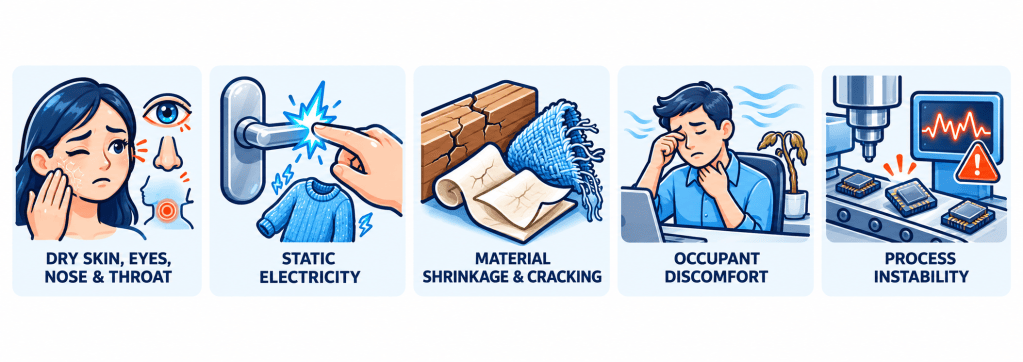
When relative humidity is too high, excess moisture can contribute to:
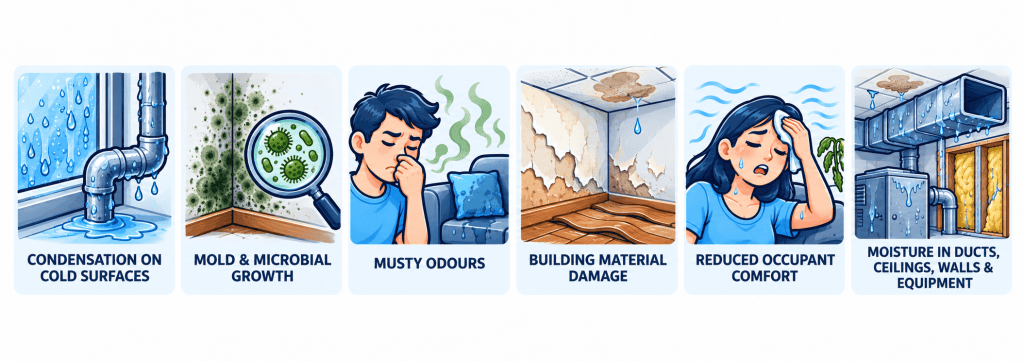
For many indoor environments, maintaining relative humidity within a controlled range helps support comfort, protect materials, and improve building performance.
What is the ideal indoor relative humidity?

A commonly targeted indoor relative humidity range is 40% to 60% RH, depending on the building type, season, climate, and application.
This range is often used because it provides a practical balance between dry-air discomfort and excessive moisture risk.
However, the ideal RH level can vary by application:
- Residential and commercial buildings require comfort-focused humidity control.
- Healthcare facilities may require tighter humidity control for patient comfort, infection control strategies, or equipment protection.
- Museums and archives require stable humidity to protect sensitive materials.
- Laboratories and industrial spaces may require specific RH levels for process stability.
- Data-sensitive environments may require humidity control to reduce static electricity risk.
The correct humidity setpoint should always consider the building envelope, ventilation rate, temperature, occupancy, and condensation risk.
How Neptronic humidifiers help control relative humidity
Neptronic humidifiers are designed to add controlled moisture to indoor air when the relative humidity falls below the desired setpoint.
In a typical HVAC system, a humidity sensor measures the current RH level. A controller compares this reading with the required setpoint. If the air is too dry, the humidifier generates or supplies moisture. The HVAC system then distributes the humidified air throughout the space or duct system.
Once the target relative humidity is reached, the humidifier modulates or stops output to prevent over-humidification.
This controlled process helps maintain stable indoor humidity instead of allowing RH levels to fluctuate with outdoor weather, heating demand, or ventilation rates.


Contact
Head Office
National Environmental Products Ltd.
Neptronic
400 Boulevard Lebeau
Montréal (Québec) H4N 1R6 Canada
E-mail: contact@neptronic.com
Copyright © 2026 Neptronic. All rights reserved.
