
What Is Dew Point?
Scientific Guide to Condensation
and Humidity | Neptronic
Dew Point Comfort Guide
Interactive guide showing how air typically feels at different dew point temperatures. Move the slider or hover over a zone to explore the comfort ranges.
Comfort interpretation
A dew point around 12°C is generally comfortable for many indoor spaces.
Why it matters
Dew point reflects the actual moisture content of the air more directly than relative humidity. A higher dew point means more moisture in the air, which can increase humidity discomfort and condensation risk in buildings and HVAC systems.
| Dew point | How the air typically feels |
|---|---|
| Below 5°C | Very dry |
| 5–10°C | Dry to comfortable |
| 10–15°C | Comfortable for many indoor spaces |
| 15–18°C | Noticeably humid |
| 18–21°C | Humid and uncomfortable for many people |
| Above 21°C | Very humid or oppressive |
Note: These are general comfort guidelines intended for education and communication. Perceived comfort can also depend on dry-bulb temperature, air movement, activity level, and building conditions.
What Is Dew Point?
Dew point is the temperature at which air becomes saturated with water vapour and condensation begins.
When air cools to its dew point, it can no longer hold all of the water vapour present in it. The excess water vapour changes into liquid water droplets. This process is called condensation.
Dew point is an important humidity measurement because it tells us the actual moisture content of the air, not just how close the air is to saturation.
Dew point explained scientifically
Air contains water vapour. The warmer the air is, the more water vapour it can hold. When air cools, its capacity to hold water vapour decreases.
If the air cools enough, it reaches a temperature where it becomes fully saturated. At this point, the relative humidity reaches 100% RH.
That temperature is called the dew point.
Once the air temperature falls below the dew point, water vapour begins to condense into liquid water. This is why condensation can appear on cold windows, metal ducts, cooling coils, pipes, or other surfaces.
In simple terms:
Dew point = the temperature where water vapour starts turning into liquid water.
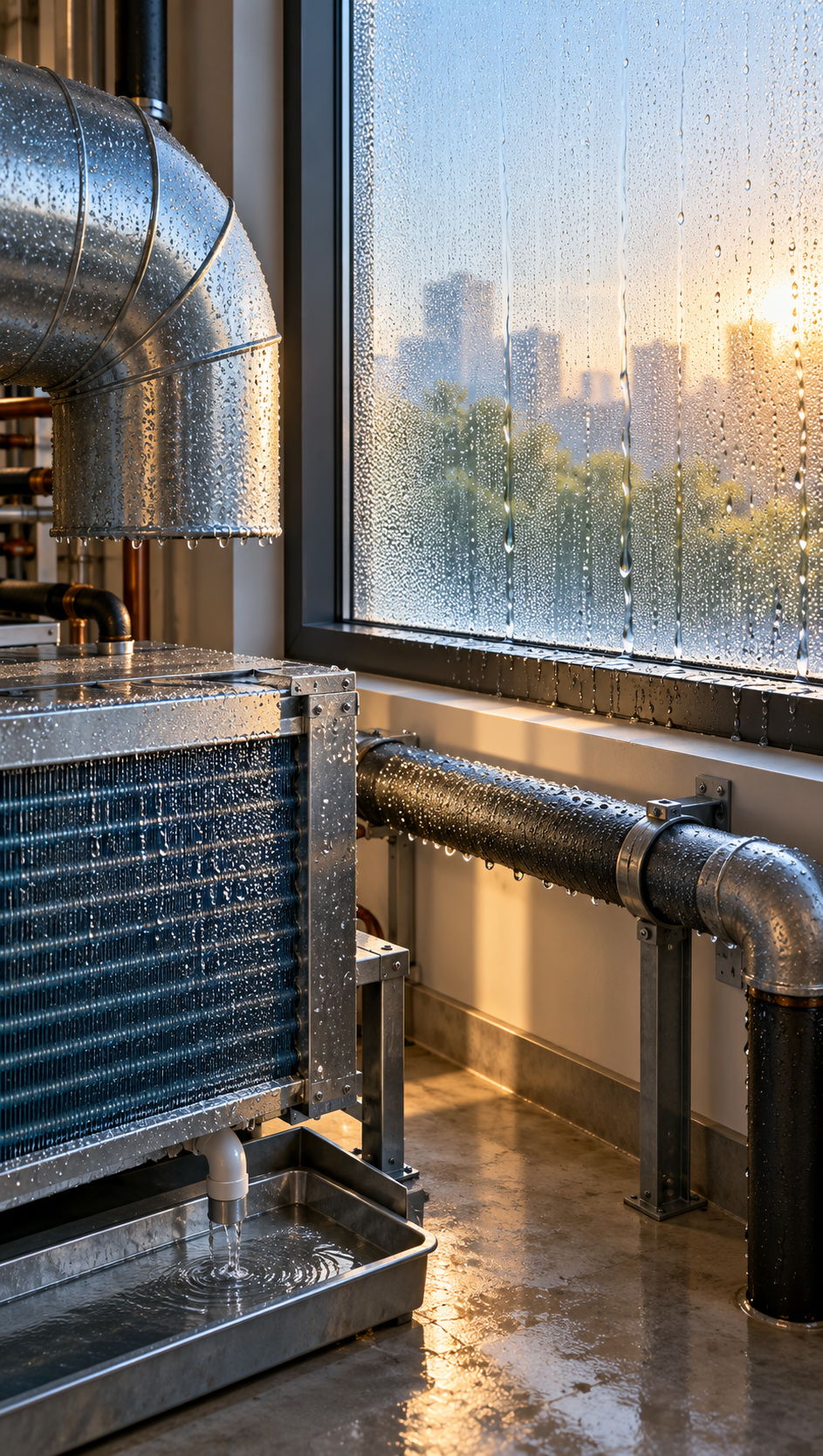
What happens at the dew point?
At the dew point, the air has reached saturation.
This means:
- The air is holding as much water vapour as it can at that temperature.
- Relative humidity is approximately 100% RH.
- Further cooling causes condensation.
- Moisture may appear as droplets, fog, dew, or frost depending on the surface temperature and conditions.
If the surface temperature is below the dew point of the surrounding air, condensation can form on that surface.
For example, if indoor air has a dew point of 12°C, any surface at or below 12°C may begin to collect moisture.
Dew point in nature
Dew point explains many natural weather conditions.
When moist air rises and cools in the atmosphere, it may reach its dew point. Water vapour then condenses into tiny droplets or ice crystals. This process forms clouds.
Depending on temperature and atmospheric conditions, this moisture can later fall as:

The same principle applies indoors. If warm, moist indoor air contacts a cold surface, condensation can occur when the surface temperature is below the dew point.
Why dew point matters more than relative humidity in some cases

Relative humidity can be useful, but it can also be misleading because it depends strongly on temperature.
Dew point gives a more direct indication of how much moisture is actually in the air.
For example:
- 25°C air at 50% RH feels more humid than 15°C air at 50% RH.
- Both have the same relative humidity.
- But the warmer air contains more actual water vapour.
- Therefore, it has a higher dew point.
This is why dew point is often a better indicator of how humid or uncomfortable air feels.
A higher dew point means there is more moisture in the air. A lower dew point means the air is drier.
Dew point and condensation risk in buildings
Dew point is important in HVAC design because it helps identify where condensation may occur.
Condensation can happen when warm, moist air comes into contact with a surface that is colder than the dew point.
Common condensation locations include:

If condensation is not controlled, it can contribute to mold growth, material damage, corrosion, odours, and reduced indoor air quality.
This is why humidity control must consider not only relative humidity, but also surface temperatures and dew point.
How dew point is different from relative humidity
Dew point and relative humidity are related, but they are not the same.
Relative humidity changes when temperature changes. Dew point stays more closely linked to the actual amount of moisture in the air.
If moisture is added to the air, the dew point rises.
If moisture is removed from the air, the dew point falls.
| Measurement | What it tells you | °C |
| Relative humidity | How close air is to saturation at the current temperature | % RH |
| Absolute humidity | Actual mass of water vapour in a volume of air | g/m³ |
| Humidity ratio | Mass of water vapour per mass of dry air | g/kg |
| Stroke Range | Auto-stroke | Specification |
Relative humidity changes when temperature changes. Dew point stays more closely linked to the actual amount of moisture in the air.
If moisture is added to the air, the dew point rises.
If moisture is removed from the air, the dew point falls.
Dew point and humidification
Humidifiers add water vapour to the air. As moisture content increases, the dew point also increases.
This is important because humidification must be controlled carefully. The goal is to maintain the required indoor humidity level without creating condensation on cold surfaces.
In a properly designed HVAC system, humidity sensors and controls help maintain the desired indoor conditions. The system must consider:
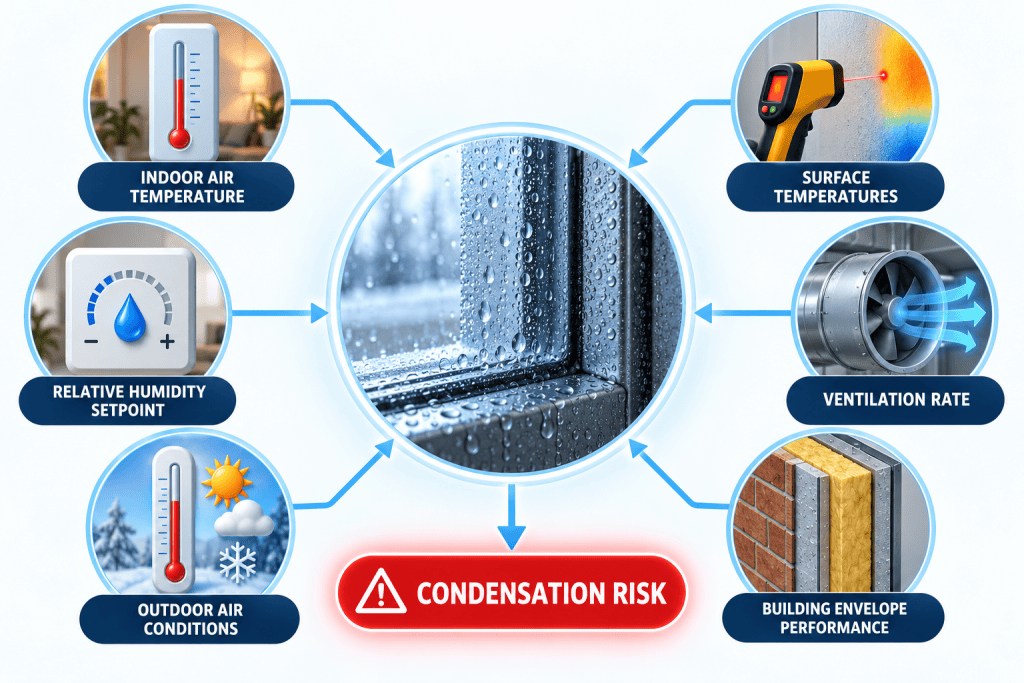
Neptronic humidifiers help add controlled moisture to the air so that indoor humidity can be maintained within the required range for comfort, materials, or process control.
Dew point and Neptronic humidifiers
Neptronic humidifiers are designed to support controlled indoor humidity in HVAC systems and specialized applications.
When indoor air is too dry, the dew point is usually low because the air contains little moisture. A Neptronic humidifier adds water vapour, increasing the air’s moisture content. This raises the humidity level and can also raise the dew point.
This controlled moisture addition helps maintain stable indoor conditions in applications such as:

For effective humidity control, dew point should be considered along with relative humidity, temperature, airflow, and condensation risk.


Contact
Head Office
National Environmental Products Ltd.
Neptronic
400 Boulevard Lebeau
Montréal (Québec) H4N 1R6 Canada
E-mail: contact@neptronic.com
Copyright © 2026 Neptronic. All rights reserved.
