What is absolute humidity?
Absolute humidity is the mass of water vapour present in a given volume of air. It is commonly expressed in grams per cubic metre (g/m³).

Calculate the actual mass of water vapour in each cubic metre of air using temperature and relative humidity—or actual vapour pressure.
Recommended HVAC range: −50 to 60°C
Absolute humidity
Each cubic metre of air contains approximately 8.64 grams of water vapour.
At 20.0°C and 50.0% RH, the air contains about 8.64 g/m³ of water vapour. Heating this air without adding moisture would lower its relative humidity while leaving its absolute humidity nearly unchanged.
Absolute humidity is the mass of water vapour present in a given volume of air. It is commonly expressed in grams per cubic metre (g/m³).
The calculator first determines actual vapour pressure, then applies the ideal-gas relationship for water vapour.
AH = pᵥ ÷ (Rᵥ × T)Absolute humidity is the actual amount of water vapour present in a given volume of air. It is usually expressed in grams of water vapour per cubic metre of air, written as g/m³.
Unlike relative humidity, absolute humidity does not describe how close the air is to saturation. It simply tells us the real moisture content of the air.
For example, if the absolute humidity is 10 g/m³, it means there are 10 grams of water vapour in every cubic metre of air.
Absolute humidity explained scientifically
Air contains water vapour in varying amounts. Absolute humidity measures the mass of this water vapour in a specific volume of air.
The basic formula is:
Absolute Humidity = Mass of water vapour ÷ Volume of air
Or:
AH = g/m³
Where:
This makes absolute humidity a direct measurement of moisture quantity. It is useful when the actual water content of the air matters, especially in HVAC design, humidification calculations, industrial processes, and environmental control.

Absolute humidity and relative humidity both describe moisture in air, but they measure different things.
Absolute humidity measures the actual amount of water vapour in the air.
Relative humidity measures how close the air is to being saturated at a specific temperature.
This distinction is important because relative humidity changes when temperature changes, even if no moisture is added or removed. Absolute humidity, however, stays almost the same unless water vapour is physically added to or removed from the air.
For example:
This is why absolute humidity is useful for understanding the actual moisture load in a space, while relative humidity is useful for understanding comfort, condensation risk, and saturation.
Temperature changes the air’s capacity to hold water vapour.
When air is heated, its maximum moisture capacity increases. If no moisture is added, the actual amount of water vapour stays the same, so absolute humidity remains nearly constant. But because the air can now hold more water vapour, the relative humidity decreases.
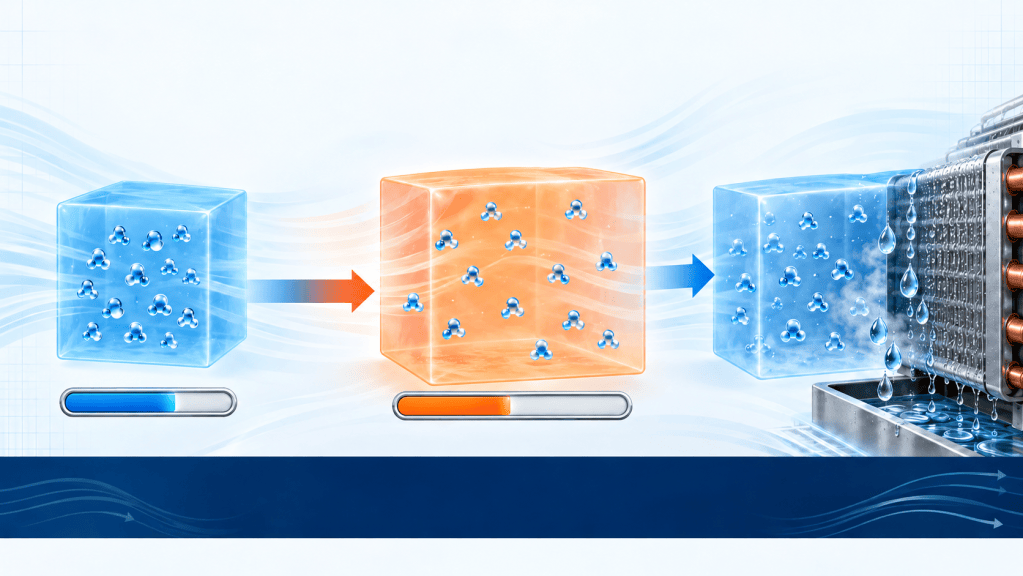
When air is cooled, its moisture-holding capacity decreases. If the air cools enough to reach saturation, water vapour begins to condense. At that point, absolute humidity can decrease because moisture leaves the air as liquid water.
This is why temperature control and humidity control are closely connected in HVAC systems.
Absolute humidity is important because it shows the real amount of moisture present in the air.
In building systems, this helps engineers and facility managers understand:

Absolute humidity is especially useful when calculating humidification loads. A humidifier must add a specific mass of water vapour to the air to raise the indoor moisture level.
Neptronic humidifiers help control indoor air conditions by adding a measured amount of moisture to the air.
When indoor air is too dry, the problem is not only low relative humidity. The air also has low moisture content. Neptronic humidifiers increase the amount of water vapour in the air, which raises the absolute humidity and helps bring relative humidity into the required range.
In an HVAC system, this process is typically controlled by humidity sensors and controllers. The system measures the indoor humidity condition, compares it with the required setpoint, and signals the humidifier to add moisture when needed.
This allows Neptronic humidifiers to support stable humidity control in applications such as:

Absolute humidity is valuable in humidifier sizing because it relates directly to the amount of water that must be added to the air.
To select the correct humidifier capacity, engineers often consider:
The larger the difference between the current moisture content and the target moisture content, the more humidification capacity is required.
This is why humidifier selection should be based on real operating conditions, not only on a general RH target.


Head Office
National Environmental Products Ltd.
Neptronic
400 Boulevard Lebeau
Montréal (Québec) H4N 1R6 Canada
E-mail: contact@neptronic.com
Copyright © 2026 Neptronic. All rights reserved.
Isothermal
Adiabatic
Coolers
SKRO | Water Treatment System
Steam Distribution Systems
Humidity Controller
